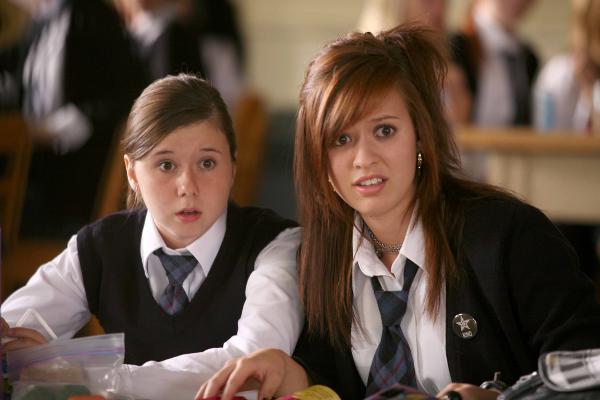
Journal d’Aurélie Laflamme, Le – Film de Christian Laurence

Le Journal d’Aurélie Laflamme est une comédie pour adolescents dont le personnage principal est tiré de la populaire série de livres écrits par l’auteure India Desjardins.

Le journal d’Aurélie Laflamme de Christian Laurence

Le journal d’Aurélie Laflamme de Christian Laurence

Le Journal d’Aurélie Laflamme est une comédie pour adolescents dont le personnage principal est tiré de la populaire série de livres écrits par l’auteure India Desjardins. Ce film est basé sur le premier tome de la série « Aurélie Laflamme, Extraterrestre ou presque ». Le réalisateur Christian Laurence vient du domaine de la télévision et signe ici son premier long-métrage de cinéma.

Comme on pouvait s’en douter d’après les succès obtenus par les livres, Le Journal d’Aurélie Laflamme fut reçu chaleureusement par le jeune public québécois qui en fit l’un des succès au box office de 2010. Au niveau international, le film de Christian Laurence eut droit à quelques sélections dans les festivals francophones, sans toutefois se démarquer outre mesure.

Un second film tiré des aventures d’Aurélie Laflamme a été produit par la suite.

Résumé

Aurélie est une adolescente de 14 ans, un peu perdue et donc en quête de solutions. Entre les habitudes de sa mère sédentaire et les chicanes avec sa meilleure amie, elle rêve à son premier french kiss ! Mais au fond, Aurélie se sent bien seule dans l'’univers, surtout depuis la mort de son père, il ya 5 ans.

Et si son père était simplement un extraterrestre, ayant quitté la Terre pour rejoindre sa planète? Génétique oblige, Aurélie serait elle-même une extraterrestre! Ceci expliquerait bien des choses. Par exemple, pourquoi elle se sent si différente des autres (surtout de sa mère), pourquoi elle n'’est pas capable d’'enligner deux mots sans faire une gaffe, et surtout pourquoi les garçons lui tapent vraiment sur les nerfs.

Synopsis officiel

Distribution

Marianne Verville (Aurélie Laflamme) ; Geneviève Chartrand (Kat) ; Aliocha Schneider (Nicolas) ; Jérémie Essiambre (Truch) ; Edith Cochrane (mère d’Aurélie) ; Pierre Gendron (Denis Beaulieu) ; Valérie Blais (Marie-Claude) ; Sylvie Potvin (Soeur Rose)

Fiche technique

Genre: Comédie dramatique - Origine: Québec, 2009 - Sortie en salles: 23 avril 2010 dans 83 salles au Québec - Durée: 1h48 - Classement: Général - Tournage: septembre-octobre 2009 - Budget approximatif: 4,1 M$

Réalisation : Christian Laurence - Scénario : Christian Laurence et India Desjardins, d'après le roman éponyme d'India Desjardins - Production : Claude Veillet et Lucie Veillet - Société de production : Films Vision 4 - Distribution : TVA Films

Équipe technique - Costumes : Julie-Anne Tremblay - Direction artistique : Marc Ricard - Montage : Hubert Hayaud - Musique : Martin Léon - Photographie : Geneviève Perron

Since you are looking for a draft related to the movie, Movie Overview & Plot

After a disastrous portrayal of the character in X-Men Origins: Wolverine (2009)—where the "Merc with a Mouth" famously had his mouth sewn shut—fans were outraged. Ryan Reynolds, who had been attached to the role since 2004, was just as disappointed. He believed, much like the hardcore comic fanbase, that the character deserved a faithful adaptation: one that embraced the R-rating, the fourth-wall breaks, and the chaotic energy that defined the source material.

In the landscape of modern cinema, few characters have made an entrance as explosive, irreverent, and universally celebrated as Deadpool. Before the first film debuted in 2016, the superhero genre was largely defined by a specific formula: a noble origin story, a clear distinction between good and evil, and a sanitized, PG-13 rating suitable for families. Then came the "Deadpool" English movie—a film that didn't just break the rules but shredded them, taped them back together, and broke them again, all while talking directly to the audience.

: The movie's official tagline is "With great power comes great irresponsibility. Bad ass. Smart ass.". Sample Dialogue Draft

The most anticipated release in the franchise is the third installment, officially titled (2024). While technically a continuation of the Deadpool English movie series, it marks Wade Wilson’s entry into the Marvel Cinematic Universe with Kevin Feige at the helm.

The character constantly breaks the fourth wall, speaking directly to the audience. He comments on the film’s budget, the actor who is playing him, and the tropes of the scene. In the English version, Ryan Reynolds’ voice is the conduit for this magic. His improv lines (of which there are many) and subtle tonal shifts are lost in dubbing.

One of the film’s most significant contributions is its groundbreaking use of R-rated content. Before Deadpool , studios believed that superheroes must be family-friendly to be profitable. The film shattered this myth, proving that an R-rating was not a limitation but a liberation. The violence is balletic and over-the-top, reminiscent of Kill Bill or John Wick , where every gunshot and sword slice is played for dark, comedic effect. Similarly, the profanity and sexual content are not gratuitous; they are the natural language of the character. Deadpool’s ability to curse, bleed, and joke about decapitation makes him feel more human and less like a plastic action figure. The film’s massive box office success—grossing over $780 million worldwide—sent an undeniable message to Hollywood: adult audiences crave superhero stories that respect their maturity.