
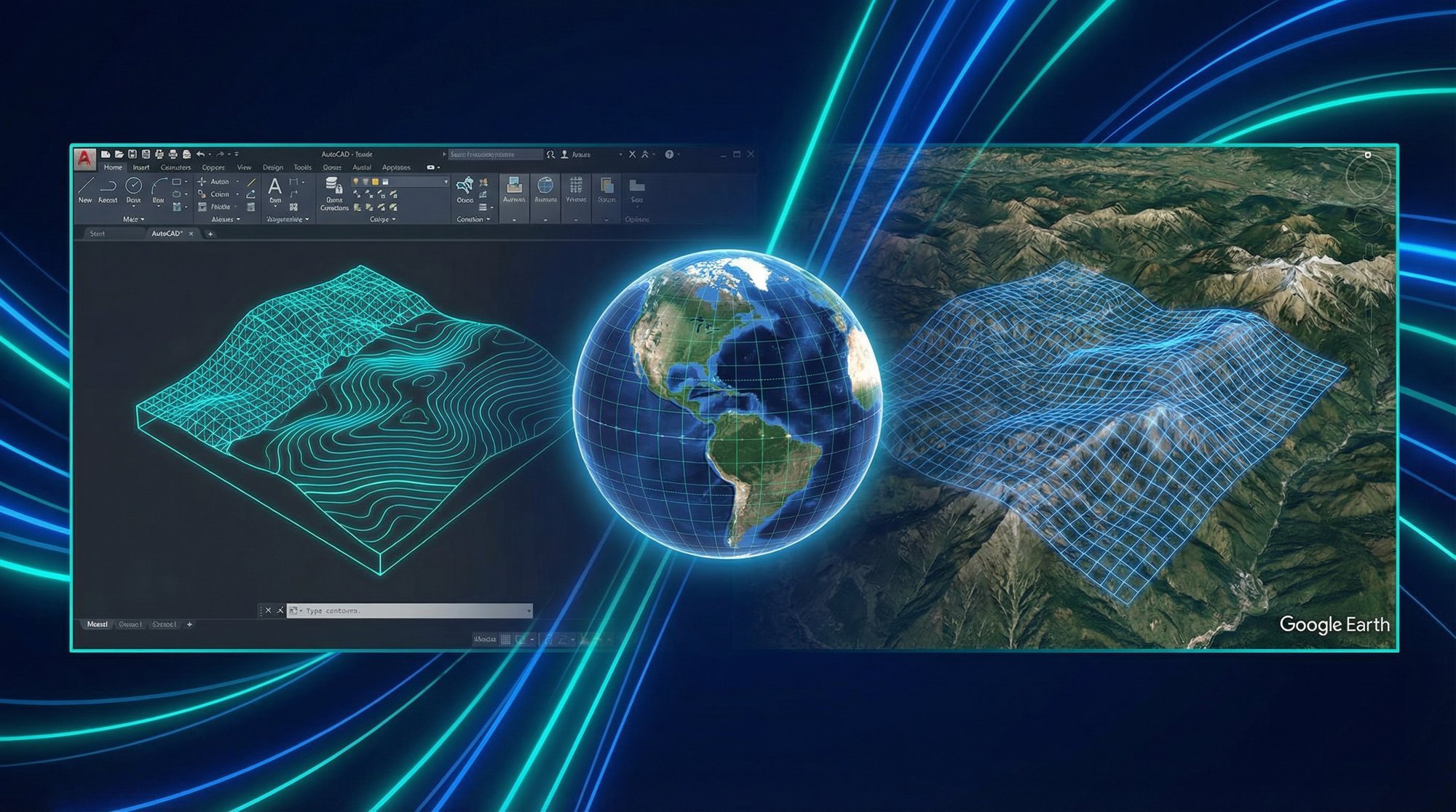
Import terrain images and meshes from anywhere in the world into AutoCAD®, Civil 3D® and other CAD platforms. Export your 3D models to Google Earth™ and SketchUp. Now with enhanced AI for superior image quality.
The most powerful version yet — with new integrations, smarter algorithms, and AI-driven enhancements.
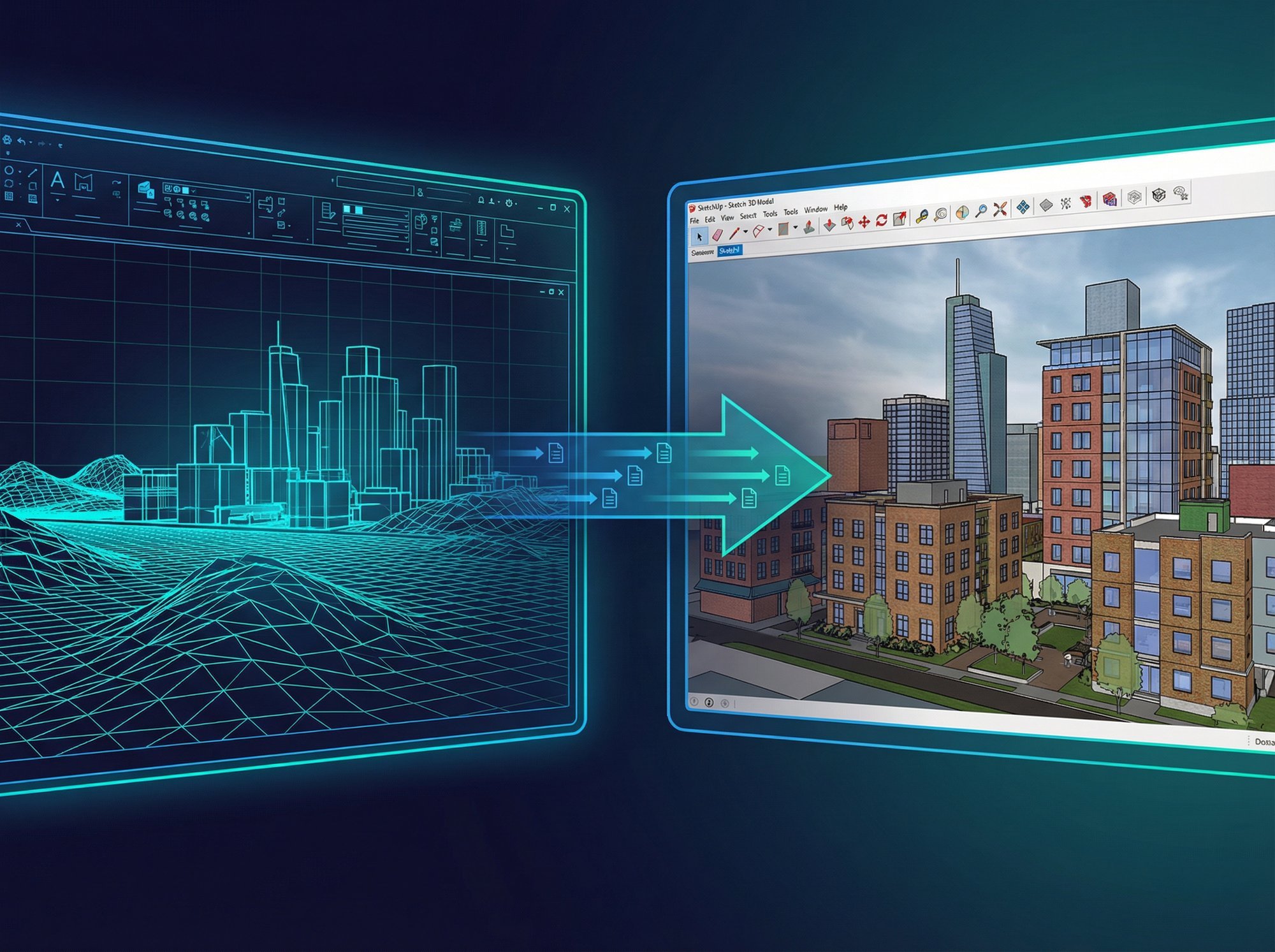
Seamlessly transfer your 3D CAD models from AutoCAD, Civil 3D and other CAD platforms directly to SketchUp for visualization and presentation.
New specialized commands to insert, delete, move, adjust elevation and edit terrain mesh vertices with greater precision and control.
Significantly faster processing with optimized algorithms for terrain analysis, volume calculations, and contour generation.
Improved AI neural network for superior image sharpness, color balance and resolution enhancement — up to 4x upscaling with natural results.
Instantly preview satellite images before importing them to ensure correct positioning and select the best provider for your project.
This beloved landscape looks "natural," but it is entirely man-made—derived from medieval sheep farming and 18th-century quarrying. Today, the economy has shifted from wool to tourism. The traditional Herdwick sheep are no longer profitable. Conservationists want to keep the sheep to maintain the short-grass aesthetic that painters like Constable celebrated. Farmers want to diversify into rewilding (letting forests return) or agro-tourism (building glamping pods).
"Museumification." This happens when a site becomes a static display for tourists, often displacing the local people or the traditional practices that created the landscape in the first place. 2. Adaptation as "Continuity"
Cultural Landscape in Practice: Conservation vs. Innovation The concept of a "cultural landscape" is inherently paradoxical. By definition, it is a space where nature and human history intersect, creating a living record of our evolution. However, in the field of heritage management, this creates a persistent tension: , which seeks to freeze a site in its most "authentic" state, and Innovation , which recognizes that for a landscape to remain "living," it must adapt to the needs of the modern world. The Traditionalist View: Conservation as Preservation
The future of cultural landscape practice lies in . True conservation is not the absence of change, but the oversight of change to ensure that the narrative of the past remains legible in the landscape of the future. When innovation is guided by heritage values, it becomes a tool for survival rather than a threat.

CAD-Earth is the most complete and affordable solution for integrating CAD with geospatial data. Here is why professionals choose us:
Commands available from toolbar, screen menu or command prompt. Automatic loading in every CAD session. Cultural Landscape in Practice- Conservation vs...
Precise coordinate conversion between your drawing and geographic coordinates using 3,000+ coordinate systems. This beloved landscape looks "natural," but it is
Perpetual licenses and annual subscriptions up to 50% more affordable than competitors. Floating licenses available. Conservationists want to keep the sheep to maintain
Online help, tutorials, video guides, email support and remote support via TeamViewer at no extra cost.
Works with AutoCAD®, Civil 3D® and other CAD platforms on Windows 7, 8 and 10 (64-bit). Integrates with Google Earth and Cesium.
Choose the plan that best fits your workflow. All plans include free technical support and updates.
Essential tools for image import and basic georeferencing.
Advanced terrain tools and full 3D model integration.
Complete solution with earthwork calculations and SketchUp export.
See a side-by-side comparison of all CAD-Earth versions and features.
This beloved landscape looks "natural," but it is entirely man-made—derived from medieval sheep farming and 18th-century quarrying. Today, the economy has shifted from wool to tourism. The traditional Herdwick sheep are no longer profitable. Conservationists want to keep the sheep to maintain the short-grass aesthetic that painters like Constable celebrated. Farmers want to diversify into rewilding (letting forests return) or agro-tourism (building glamping pods).
"Museumification." This happens when a site becomes a static display for tourists, often displacing the local people or the traditional practices that created the landscape in the first place. 2. Adaptation as "Continuity"
Cultural Landscape in Practice: Conservation vs. Innovation The concept of a "cultural landscape" is inherently paradoxical. By definition, it is a space where nature and human history intersect, creating a living record of our evolution. However, in the field of heritage management, this creates a persistent tension: , which seeks to freeze a site in its most "authentic" state, and Innovation , which recognizes that for a landscape to remain "living," it must adapt to the needs of the modern world. The Traditionalist View: Conservation as Preservation
The future of cultural landscape practice lies in . True conservation is not the absence of change, but the oversight of change to ensure that the narrative of the past remains legible in the landscape of the future. When innovation is guided by heritage values, it becomes a tool for survival rather than a threat.
Watch tutorials and feature demonstrations on our YouTube channel.