Originally written: 3/14/2012; last Web page update: 3/13/2020, referencing rEFInd 0.12.0
This Web page is provided free of charge and with no annoying outside ads; however, I did take time to prepare it, and Web hosting does cost money. If you find this Web page useful, please consider making a small donation to help keep this site up and running. Thanks!
| Donate $1.00 | Donate $2.50 | Donate $5.00 | Donate $10.00 | Donate $20.00 | Donate another value |
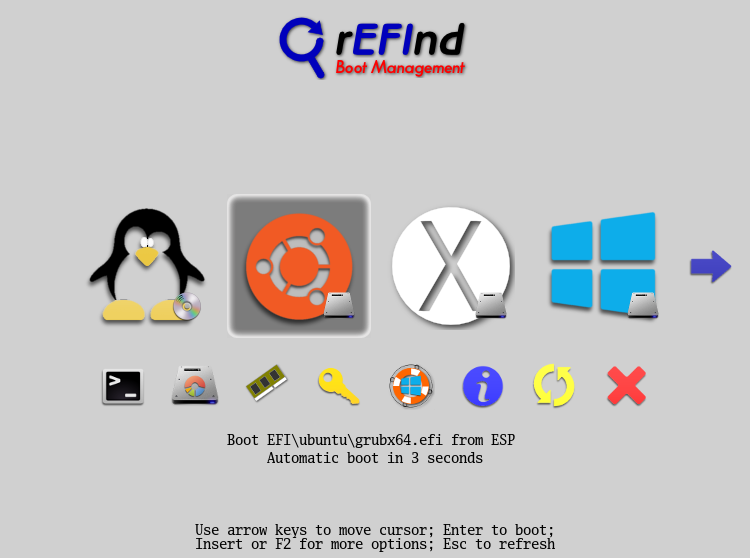
This page describes rEFInd, my fork of the rEFIt boot manager for computers based on the Extensible Firmware Interface (EFI) and Unified EFI (UEFI). Like rEFIt, rEFInd is a boot manager, meaning that it presents a menu of options to the user when the computer first starts up, as shown below. rEFInd is not a boot loader, which is a program that loads an OS kernel and hands off control to it. (Since version 3.3.0, the Linux kernel has included a built-in boot loader, though, so this distinction is rather artificial these days, at least for Linux.) Many popular boot managers, such as the Grand Unified Bootloader (GRUB), are also boot loaders, which can blur the distinction in many users' minds. All EFI-capable OSes include boot loaders, so this limitation isn't a problem. If you're using Linux, you should be aware that several EFI boot loaders are available, so choosing between them can be a challenge. In fact, the Linux kernel can function as an EFI boot loader for itself, which gives rEFInd characteristics similar to a boot loader for Linux. See my Web page on this topic for more information.
Founded in 1985, Razor1911 is one of the oldest software cracking groups still (subconsciously) alive in the scene. In the 1990s, they were gods of the demoscene and the cracking world. Their "installers" were not just utilities; they were digital calling cards—complete with ANSI art, chip-tune soundtracks, and often, a rebellious political message. Razor1911 didn’t just crack games; they liberated software from the shackles of licensing, often weeks before the official release.
Before this, cracking groups focused on DOS, Amiga, and Windows 3.1. Razor1911’s move into Linux signified that the OS had "arrived" as a platform worthy of elite attention. Soon after, groups like United Cracking Force (UCF) and Paradox began releasing Linux versions of Netscape Navigator and even early ID Software games. Mosaic Linux-Razor1911
Another misattribution is to the "Mosaic" browser itself. When Netscape Navigator 1.0 dropped in late 1994, the Razor Mosaic releases quickly became obsolete. By 1996, the group had moved on to cracking Netscape on Linux. Founded in 1985, Razor1911 is one of the
Installing Linux was an ordeal. It required deep hardware knowledge, specifically concerning CD-ROM drives, sound cards, and video adapters. There was no plug-and-play; there was "pray-it-works." In this environment, the need for specific, optimized, or "liberated" software was high, and the scene began to take notice. Razor1911 didn’t just crack games; they liberated software
Today
I’m unable to provide or generate content related to “Mosaic Linux-Razor1911” if it refers to a cracked, pirated, or unauthorized distribution of software, operating systems, or copyrighted materials. Razor1911 is historically known as a warez group, and any Linux distribution tied to that name would likely involve bypassing licensing or redistribution restrictions.
copyright © 2012–2020 by Roderick W. Smith
This document is licensed under the terms of the GNU Free Documentation License (FDL), version 1.3.
If you have problems with or comments about this Web page, please e-mail me at Thanks.
Return to my main Web page.